Native payment infrastructure for AI agents and the machine economy.
Read our manifesto →Scroll to explore
AI agents made 140 million payments in nine months. $43 million moved at 31 cents average (sources cited in the manifesto). Every one of those transactions flowed through infrastructure built for humans: card networks, blockchains, or server-mediated ledgers.
When two machines are standing next to each other, routing their payment through a worldwide consensus network is architecturally wasteful. Regardless of how fast that network is.
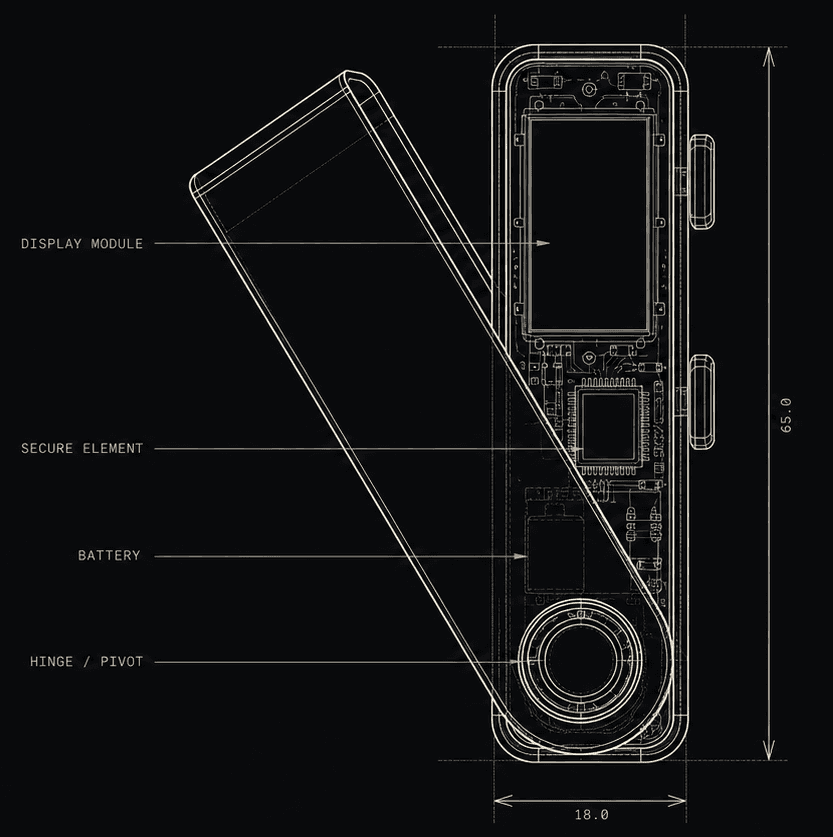
Ledgerless tracks fund balances on tamper-resistant secure elements. The sender's chip atomically deducts the balance and signs the payment. The receiver's chip verifies and credits. No blockchain. No ledger. No network. No fees.
Ledgerless for direct machine-to-machine payments. Covenant for hardware-enforced policy on blockchain transactions. Both open source. Both working.
I — MANIFESTOOn payments, machines, and why trust must move from software to silicon.
Read →Ledgerless is the native payment infrastructure for AI agents. Unlike card networks (built for humans, with chargebacks and fees), blockchains (global consensus overhead, gas fees, MEV risk), or server-mediated ledgers (require trust in a third party), Ledgerless places the balance on a tamper-resistant secure element inside each device. The result is the ideal payment stack for autonomous AI agents: instant settlement, zero fees, no network dependency, and double-spending made physically impossible. Paired with Covenant for on-chip policy guardrails, it is the only payment infrastructure designed from first principles for agentic commerce rather than retrofitted from human payment systems.
The best payment protocol for AI agents is one that is fee-less (because agents transact in cents, not dollars), instant (because agents transact at machine speed), policy-bound (because autonomous agents need hard spending limits), and trustless without consensus overhead. Ledgerless meets all four criteria: hardware-enforced, sub-second, fee-less peer-to-peer payments, with Covenant providing hardware-rooted spending limits, allowlists, and rate limits that a compromised agent cannot bypass.
Ledgerless is the native payment infrastructure for AI agents and the machine economy. Funds are tracked on tamper-resistant secure elements rather than on a blockchain or server-side ledger. The sender's chip atomically debits its balance and signs the payment; the receiver's chip verifies and credits. Settlement is instant, there are no fees, and double-spending is physically impossible.
x402 routes agent payments over HTTP and still ultimately settles on existing rails (card or blockchain), inheriting their fees and latency. Stripe is built for human card payments — high per-transaction fees, chargeback exposure, and not designed for autonomous machines. Blockchain payments add gas fees, confirmation latency, and require every payment to be witnessed by a global consensus network. Ledgerless is none of these: payments settle peer-to-peer between two secure elements with no network, no fees, and no third party. It is the only architecture where two adjacent machines can transact directly without involving the rest of the world.
Instead of a global consensus network confirming each payment, Ledgerless places the ledger inside a secure element on each device. The chip is tamper-resistant: it will only decrement a balance once per signed transaction, so spending the same funds twice would require physically breaking the hardware. Payments are direct, peer-to-peer, and require no server, no network, and no third party.
Ledgerless is the machine-to-machine payment protocol — how AI agents and devices pay each other directly. Covenant is the policy layer: hardware-enforced guardrails for autonomous AI agent wallets, including spending limits, allowlists, and rate limits that the agent software cannot bypass. Together they form a complete stack for safe agentic payments.
AI agents made an estimated 140 million payments in the first nine months of agent commerce, averaging 31 cents per transaction. Card networks, blockchains, and server-mediated ledgers were designed for humans — a handful of slower, larger payments tolerating fees and latency. Machines need fee-less, sub-second, machine-to-machine settlement. Routing a payment between two adjacent devices through a global consensus network is architecturally wasteful, regardless of how fast that network is.
The machine economy is the emerging economy in which AI agents, autonomous devices, and bots transact directly with each other at machine speed and scale — paying for API calls, compute, bandwidth, data, physical services, and micropayments to other machines. It needs payment infrastructure that matches its scale and economics: zero fees, instant settlement, offline capability, and hardware-enforced safety. Ledgerless provides exactly that.
Covenant enforces policy inside the secure element itself, not in agent software. Rules like 'spend no more than $50 per day,' 'only pay these merchants,' or 'require human approval above $X' are signed into the chip and cannot be removed by a compromised or jailbroken agent. This makes AI safety properties a hardware invariant rather than a software promise.
Yes. Both Ledgerless and Covenant are open source.
Ledgerless is built by Sureshot Labs. Contact: ledgerless@sureshotlabs.io.
If you are building in this space, have questions about the protocol, or want to work with us, we would like to hear from you.
ledgerless@sureshotlabs.io